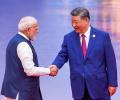
For India, China's Indian Ocean power projection, maritime domain awareness, dual-use ports, underwater surveillance, antisubmarinewarfare, naval exercises with Pakistan, pose considerable pressure, depleted India's strategic depth and marginalises Indian role, points out Srikanth Kondapalli.

Paras Defence and Space Technologies partners with Northstar Aviation to provide air-to-air refuelling technologies and support services to the Indian armed forces, enhancing mission endurance and operational flexibility.
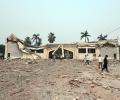
'We won not (only) because we were able to carry out long-range precision strikes.' 'That is, of course, one of the reasons but we had better situational awareness about what's happening than Pakistan.'
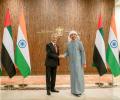
Frankly, was it really necessary in the middle of a fratricidal war for External Affairs Minister S Jaishankar to travel to Abu Dhabi for a one-on-one with the sheikh on April 12?Or, for National Security Advisor Ajit Doval to follow up on April 26? Or, for PM Narendra Modi to follow through today? There are no easy answers, notes Ambassador M K Bhadrakumar.
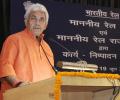
Jammu and Kashmir Lieutenant Governor Manoj Sinha emphasised the importance of harnessing sports as a force for social transformation at a national 'Chintan Shivir' in Srinagar. He highlighted the need for collaboration between schools, communities, and families to create ecosystems where young athletes can discover their potential, and urged for greater support and resources for physical education teachers in schools.

US President Donald Trump is reportedly considering military action against Iran due to stalled negotiations and Tehran's approach to its nuclear issue, according to CNN sources. Divisions within the Trump administration have emerged over the next course of action, with some officials advocating for a more aggressive approach through targeted military strikes.

The Centre had asked the Gymkhana Club in Lutyens' Delhi to hand over the premises, citing that the 27.3-acre plot was required for "strengthening and securing defence infrastructure".

US-based Redwood Software has inaugurated its global centre in Hyderabad, designating it as its primary operational location. The centre will focus on AI-powered automation and aims to enhance Redwood's ability to manage operations across hybrid IT environments. Redwood plans to hire over 300 new employees by the end of 2027.

On the first anniversary of Operation Sindoor, the Indian military issued a stern warning to Pakistan, stating that no terror sanctuary across the border is safe and that India will continue to dismantle terrorist infrastructure.

Chinese President Xi Jinping warned US President Donald Trump that mishandling the Taiwan issue could trigger conflicts between the two countries during wide-ranging talks on trade, Iran, and energy security.

US Secretary of State Marco Rubio said that discussions aimed at halting the conflict with Iran have shown "some slight progress," while simultaneously echoing Washington's dissatisfaction with its NATO allies.

Although extensive air attacks have been carried out to destroy most of Iran's defence capabilities, the latter's resilience and sustenance during the war clearly indicate that the US landing force would encounter severe resistance in the operation, explains Commodore Venugopal Vengalil (retd).

Delhi must now purge the delusional hopes of being a 'counterweight' to China in the US calculus, argues Ambassador M K Bhadrakumar.

Chinese leaders, including its generals, will have to weigh whether they can win a war if they ever attack Taiwan and if at all, can they sustain the subsequent devastation, notes Rup Narayan Das.

A senior Iranian legislator has suggested that Tehran could further escalate pressure on its adversaries by targeting the Bab el-Mandeb Strait, raising concerns about global supply chain vulnerabilities.

Satwiksairaj Rankireddy and Chirag Shetty progressed to the Thailand Open Super 500 final after defeating Goh Sze Fei and Nur Izzuddin. The Indian duo attributed their success to mental fortitude gained from overcoming injuries and setbacks.
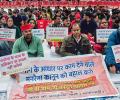
The Centre has notified draft rules for the Viksit Bharat - Guarantee for Rozgar and Ajeevika Mission (Gramin) Act, 2025, outlining the framework for the new rural employment programme replacing MGNREGA. The draft rules are open for public feedback until June 21, 2026.

Donald Trump says several issues were settled during the final day of talks with Xi Jinping covering trade, tariffs, and diplomacy.
David Perdue said in a post on X that the US-India relationship delivers real results through close cooperation in diverse areas, including defence, energy and through Quad engagement.

'Leadership is about understanding how a business works, how it is shaped, built, and expanded.'

The IRGC said the strikes were conducted in support of offensives by Hezbollah and residents of southern Lebanon, and described them as the beginning of a series of pre-announced operations against Israel.

The United States' historical strategic alignment with Pakistan, dating back to the Cold War, has consistently aimed to create a political and military parity with India, despite India's significantly larger size and resources. This long-standing relationship continues to influence regional dynamics, particularly in West Asia and the Indo-Pacific.

The US blockade on Iranian ports is aimed to curb Iranian energy exports, thereby crippling its economy to force Iran back to the negotiating table, points out Commodore Venugopal Menon (retd).

Cricket Canada has appointed Monty Desai as the head coach of its men's national team, aiming to rebuild after allegations of corruption and mismanagement. Desai's experience with associate nations like Nepal and Afghanistan is expected to bring transformation through leadership and discipline.

A review of the IPL 2026 season, highlighting the successes of Royal Challengers Bengaluru and Gujarat Titans, while noting the disappointing performances of Mumbai Indians and Lucknow Super Giants, setting the stage for significant changes.

West Bengal BJP president Samik Bhattacharya has expressed the state government's desire for the Tata Group to return to Singur, viewing it as an economic necessity and a signal that West Bengal is open for business. The move aims to reverse the negative perception created when the Nano project was forced out of the state.

The BJP's landslide victory in West Bengal has not merely redrawn the electoral map but overturned the operating logic of politics in the state, breaching the TMC's entrenched fortress despite a decade-and-a-half of dominance, minority consolidation, and a sustained "outsider" narrative.

Iran has placed anti-personnel and anti-armour mines around the island, where US troops could potentially stage an amphibious landing.

According to an official Iranian military statement, Qader anti-ship cruise missiles were launched at the carrier, forcing it to alter its position in the region.

The Iranian military has asserted that its forces successfully targeted and downed a US A-10 aircraft, according to a report by Al Jazeera.

United States President Donald Trump has welcomed the declaration from Tehran regarding the restoration of maritime access through the Strait of Hormuz.
Islamabad's attempt to position itself as a mediator in the West Asia conflict has come to naught with the Iranian side refusing to meet any US-led delegation in Pakistan, reports the Wall Street Journal.
Pakistan has intensified its efforts to bring the US and Iran back to the negotiating table to end the war in West Asia, following President Trump's extension of the ceasefire. Pakistani officials have engaged with Iranian, Turkish, and British counterparts to promote dialogue and diplomacy for a peaceful resolution.

The fragile ceasefire in West Asia between the US and Iran to halt the hostilities in the region for two weeks faces renewed uncertainty as Tehran reportedly moved to block the strategic Strait of Hormuz once again due to Israel's intensified offensive against Hezbollah in Lebanon, according to Iranian state media Islamic Republic News Agency (IRNA), which US President Trump says was "not included" as part of the ceasefire deal.

The Congress party experienced a significant decline in the Brihanmumbai Municipal Corporation (BMC) elections, winning a mere 15 seats out of 227. Analysts attribute the poor performance to strategic missteps, infighting, and a failure to connect with voters amidst linguistic and religious polarization.

Deloitte India has partnered with IIT Bombay to launch a Quantum Technology Centre, aiming to accelerate quantum adoption, research, and enterprise use-cases for Indian businesses.

If current trends persist, the Congress risks becoming increasingly regionally concentrated, dependent on a handful of states rather than functioning as a truly pan-India political force.

US Secretary of War Pete Hegseth on Wednesday claimed that Tehran "begged" for a truce, maintaining that Washington achieved a "decisive military victory" during 'Operation Epic Fury.'

A senior US official has emphasised India's crucial role in maintaining peace and stability in the Indo-Pacific region and ensuring a balanced power dynamic in Asia, advocating for stronger defence ties between the two nations.

Is Bhutan merely experimenting with digital finance -- or is the Himalayan kingdom punching far above its weight, quietly playing one of the most sophisticated strategic games in Asia today? asks Varun Arya.
